
Germany's Apprentice Crisis: Why NRW's Mittelstand Can't Find Workers
By the AzubiPrep Research Desk, Cologne · Sources: Bundesagentur für Arbeit, BIBB, IW Köln, DIHK, ZDH, Destatis, ifo Institut
Bryan Rattan
6/3/20265 min read
Why the Domestic Pipeline Alone Cannot Fix This
The structural explanation is well-documented. Germany's Akademisierungstrend — the decades-long cultural preference for university study over vocational training — has steadily eroded the apprenticeship pipeline. The BIBB data shows the number of new training contracts is not recovering to pre-2019 levels. Meanwhile, the Handwerkskammer Düsseldorf notes a degree of renewed interest among younger applicants in 2025/2026. But interest is not supply. A renewed interest in apprenticeships today produces qualified tradespeople in 2028 at the earliest.
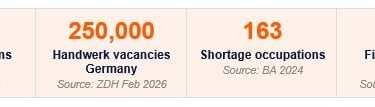
The ZDH (Zentralverband des Deutschen Handwerks) estimated in February 2026 that approximately half of the 250,000 unfilled Handwerk positions cannot be filled because there are simply no domestic applicants available — at any wage level. This is the critical distinction. This is not a pricing problem. It is a supply problem.
The International Pathway: § 81a and What It Actually Enables
The Fachkräfteeinwanderungsgesetz (Skilled Workers Immigration Act) and specifically the § 81a accelerated procedure were designed precisely for this gap. The § 81a process allows qualified candidates from non-EU countries — specifically those entering for the purpose of recognised vocational training — to receive an accelerated visa decision, bypassing the standard 12-month administrative queue. NRW's Ausländerbehörden have been actively processing § 81a applications, particularly for candidates in Pflege, SHK, Elektro and Handwerk.
The eligibility condition that matters most: B2-level German. Candidates without verified B2 do not clear employer expectations or immigration requirements. Candidates with verified B2 move to the front of a very short queue.
What This Means in Plain Terms
The data does not require interpretation. Germany has a structural, demographically-driven shortage of vocational workers. NRW has 56,392 unfilled skilled positions. The four sectors most affected — Pflege, SHK, Elektro and Handwerk — are precisely those where the Ausbildung route, not a university degree, is the entry path. The § 81a process exists to accelerate qualified international candidates into these roles. And 57% of all unfillable German positions require exactly the qualification an Ausbildung produces.
AzubiPrep does not manufacture urgency. The urgency is in the official record. We simply read it, act on it, and prepare candidates to meet the exact standards the market is demanding.
Germany has a problem it cannot train its way out of fast enough. The Bundesagentur für Arbeit counts 163 official shortage occupations as of 2024. The Institut der deutschen Wirtschaft (IW Köln) calculated 487,029 positions that could not be filled. The DIHK reports that 36% of German companies still face serious recruitment difficulties in 2025/2026. The ifo Institute is clear: any recent easing is cyclical, not structural. The shortage is permanent.
North Rhine-Westphalia sits at the epicentre. In 2025 alone, 56,392 skilled positions went unfilled in the state — 26.7% of all open roles. The hardest-hit sectors are not abstract. They are the tradespeople who keep the infrastructure of daily life running.
Pflege (Nursing & Healthcare): The most acute crisis in Germany. Over 46,000 positions went unoccupied nationally in 2024 — more than any other sector. The Federal Statistical Office (Destatis) projects a need for 280,000 to 690,000 additional care workers by 2049. Vacancy times in Q1 2026 exceed 240 days. This is not a temporary dip. It is structural, driven by an ageing population and decades of underinvestment in training capacity.
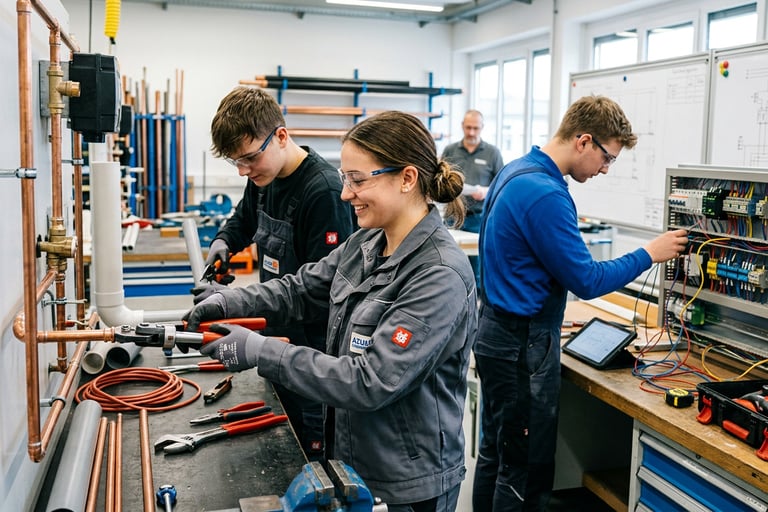
SHK — Sanitär, Heizung, Klima (Plumbing, Heating & Air Conditioning): Over 12,000 positions unoccupied nationally, with NRW carrying a disproportionate share. The Energiewende (energy transition) and Germany's enormous building retrofit backlog have pushed demand for SHK professionals to record levels. Firms are now hiring career-changers without formal qualifications and training them internally — a measure of genuine desperation.
Elektrotechnik (Electrical Engineering): In NRW alone, 2,889 electrician positions went unfilled in 2025. Renewable energy installation, smart grid upgrades and building modernisation are driving explosive demand. The Handwerkskammer Düsseldorf reported a notable increase in new apprenticeship contracts in this sector in early 2026 — but supply still falls far short of need.
Handwerk (Skilled Trades — General): Nationally, 250,000 Handwerk positions are unfilled as of February 2026 (Zentralverband des Deutschen Handwerks). Roughly half cannot be filled because there are simply no applicants. In the construction sub-sector, 62% of firms report inability to fill positions (DIHK 2025/2026). The BIBB Berufsbildungsbericht 2025 confirms that 19,000 apprenticeship positions in the skilled trades went unoccupied in 2024 alone.
The root cause is structural: Germany's Akademisierungstrend — the cultural shift toward university over vocational training — has drained the apprenticeship pipeline for a generation. Meanwhile, the Babyboomer cohort is retiring en masse. By 2030, the working-age population will shrink by 3 to 4 million people (IAB). No domestic policy response will close this gap in time.
57% of all unfillable positions require dual vocational training (Berufsausbildung), not a university degree (DIHK 2025/2026). The solution is not more academics. It is more Azubis.
AzubiPrep exists precisely because the data is unambiguous. NRW's Mittelstand needs motivated, qualified apprentices. Indian candidates with B2 German certification represent one of the most viable and underutilised talent pipelines available. The § 81a Accelerated Professionals Act exists to fast-track exactly this. We use it.

North Rhine-Westphalia: The Numbers on the Ground
In 2025, approximately 56,392 skilled positions went unfilled in NRW — representing 26.7% of all open roles in the state (IW Köln). This is not evenly distributed. The pressure concentrates in four sectors that form the backbone of the state's Mittelstand economy.
1. Pflege — Nursing and Care
The most acute shortage in Germany, and it is worsening. The Federal Statistical Office (Destatis) projects a national need for between 280,000 and 690,000 additional care workers by 2049. In Q1 2026, care positions registered a vacancy time exceeding 240 days — the longest of any occupational category tracked by the Bundesagentur für Arbeit. Over 46,000 positions nationally went unoccupied in 2024 alone. The Techniker Krankenkasse (TK-Gesundheitsreport 2025) documents the human cost: care workers register significantly above-average sick days, with 72% of senior care staff reporting physical strain and 59% reporting psychological burden. The sector is not just understaffed. It is burning through the staff it has.
2. SHK — Sanitär, Heizung, Klima
Plumbers, heating engineers and air conditioning technicians. Over 12,000 positions unfilled nationally, with NRW disproportionately affected given its density of ageing residential and commercial building stock. The Energiewende — Germany's legally mandated transition to renewable energy — has created an almost unlimited pipeline of installation and retrofit work. Heat pump installations, solar thermal systems, building insulation upgrades: all require SHK specialists. Firms are openly hiring career changers without formal qualifications and training them internally. That is not a solution. That is a symptom.
3. Elektrotechnik — Electrical Engineering
In NRW alone, 2,889 electrician positions went unfilled in 2025. Nationally, the ZDH reported approximately 250,000 unfilled Handwerk positions as of February 2026, with Elektro and SHK identified as the hardest-hit sub-sectors. The Handwerkskammer Düsseldorf reported a notable increase in new apprenticeship contracts in electrical trades in early 2026 — genuine market signal that training interest is rising. But new apprenticeships take three years to produce qualified tradespeople. The gap is not closing at speed.
4. Handwerk — The Broader Trades Picture
The BIBB Berufsbildungsbericht 2025 — the Federal Institute for Vocational Education and Training's annual benchmark report — confirmed that 486,700 new apprenticeship contracts were signed by 30 September 2024, approximately 2,500 fewer than the previous year. In the Handwerk sector, 19,000 positions went unoccupied despite being advertised. The DIHK reports that in the Tiefbau (civil construction) sector, 62% of firms cannot fill their open positions. The IHK Rheinland Fachkräftereport confirms that 35.9% of positions requiring completed vocational training went unfilled in the Rhine region.


Editorial note: This brief was researched and written by the AzubiPrep team in Cologne, drawing exclusively on publicly available institutional data. It does not constitute legal or immigration advice. For individual guidance, contact contact@azubis.in.
Azubi Prep
Cologne-headquartered preparation academy for state-regulated German apprenticeships.
Sitemap
Cologne Headquarters
Azubi Prep
Cologne, North Rhine-Westphalia
contact@azubis.in
(C) 2026 Azubi Prep-AzubiPrep is an educational consulting academy and does not act as a recruitment agency or charge placement commissions under German or Indian law. Read our full Legal Disclaimer